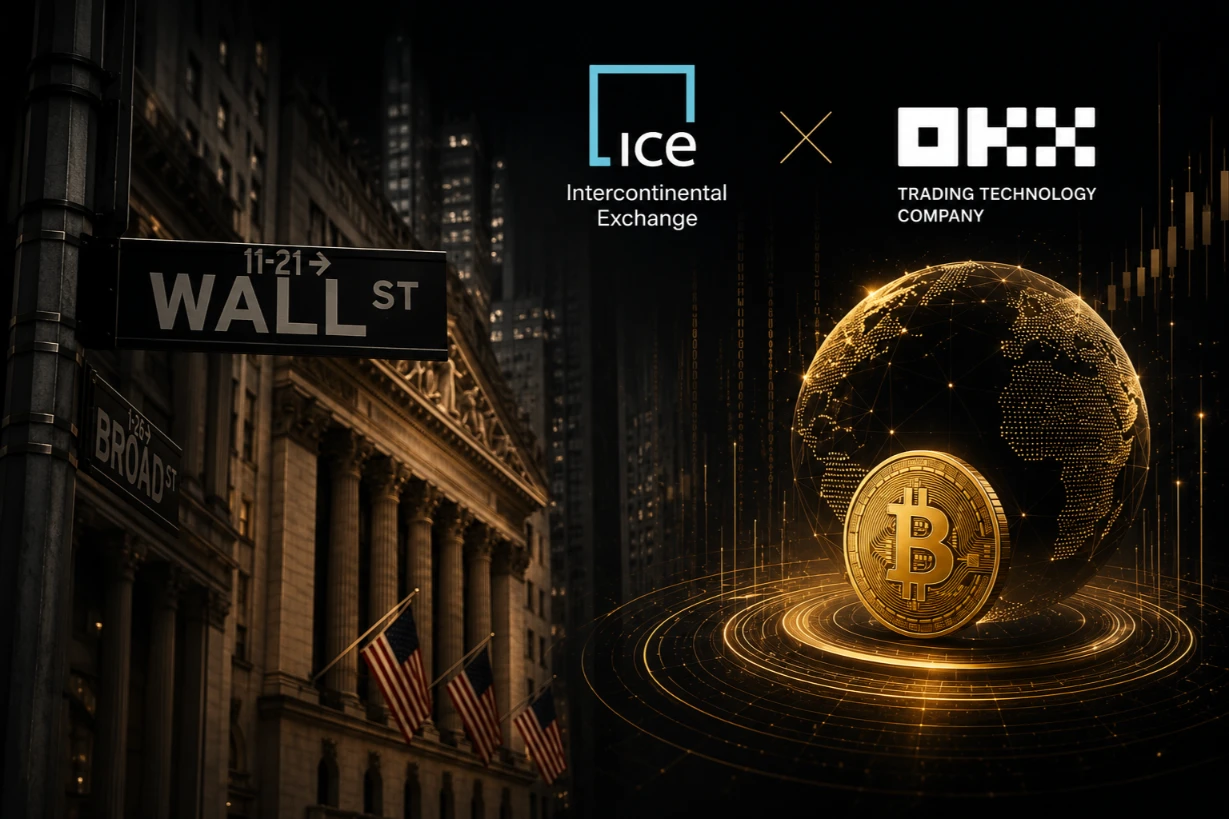
On June 22nd, Intercontinental Exchange (NYSE: ICE) and OKX announced that they were forming a joint venture focused on building a new-generation infrastructure for tokenized and digital-native financial assets.
We decided to focus on this partnership because it shows that rather than stepping back, an established financial institution is deepening its collaboration with a crypto-native company.
This is especially important now because the cryptocurrency market has been grappling with subdued prices and cautious investor sentiment for quite some time.
In this short analysis, we’ll explore this collaboration and how it reinforces the trend of traditional finance and cryptocurrencies coming together.
Why This Partnership Matters
One of the main reasons why this partnership matters is that Intercontinental Exchange (ICE) and OKX together bring decades of experience across traditional capital markets and digital assets.
Intercontinental Exchange owns and operates major exchanges like the New York Stock Exchange (NYSE).
ICE also operates 6 clearing houses across different countries, has its own Mortgage Technology, provides fixed income & market data services, and much more. This makes it a focal point in traditional finance (TradFi).
On the other hand, OKX is one of the largest blockchain technology and trading companies, serving more than 120 million users in over 100 countries.
OKX has been hailed for its deep liquidity and innovation. The platform has consistently invested in improvements to user experience, security, and its suite of financial products.
Scope Of The ICE-OKX Partnership
According to the press release, the joint venture will operate as a U.S.- registered broker-dealer and Futures Commission Merchant.
It will enable OKX’s customers, including those in the United States, to access ICE futures and NYSE tokenized equities markets. This is, of course, subject to certain regulatory approvals.
The companies also plan to identify additional blockchain applications that comply with existing financial regulations, potentially expanding the scope of digital asset infrastructure.
Leadership Of The Partnership
The leadership of this venture is also worth noting.
The joint venture will be co-chaired by ICE and Former New York Governor Andrew Cuomo, who started working as a paid adviser to OKX in 2023.
Cuomo has long expressed support for cryptocurrencies and blockchain technology. As governor, he signed legislation in 2019 establishing the nation’s first task force to study the regulation and legal definition of the sector.
According to the former Governor, the partnership will help build a more modern, transparent, and resilient financial system for the future.
He believes that such collaborations could democratize finance, bringing basic financial services to underserved populations.
Intercontinental Exchange’s Investment in OKX
The recent partnership comes after Intercontinental Exchange made a significant investment in OKX, announced on March 5.
While the exact value and terms of the investment were not disclosed, ICE stated that its investment reflected an OKX valuation of $25 billion.
According to the March press release, the partnership will see ICE have a seat on OKX’s Board of Directors as the two companies pursue several strategic initiatives.
The initiatives include:
- Launching U.S.-regulated crypto futures using OKX’s spot price data
- Expanding access to ICE’s U.S. futures and NYSE tokenized equities through OKX
- Collaborating on institutional digital asset infrastructure, including custody, clearing, risk management, wallet architecture, and multi-chain connectivity.
Crypto and Trading Are Coming Closer Than Ever
The ICE-OKX joint venture coming less than four months after ICE’s strategic investment suggests that these two companies view blockchain-enabled financial infrastructure as a strategic priority, not a speculative one.
But the announcement is not happening in isolation. A growing number of developments have demonstrated that the relationship between traditional finance and the crypto industry is evolving from cautious observation into active collaboration.
Here are some of the developments:
1. In March 2026, Kraken made history after its banking arm, Kraken Financial, became the first digital asset bank to receive a limited-purpose Federal Reserve master account.
Beyond improving operational efficiency, the milestone represents one of the clearest signs yet that crypto companies are beginning to integrate into the core infrastructure of the U.S. financial system.
2. In May, Elliptic, one of the largest digital asset intelligence firms, announced the closing of a $120 million Series D funding round led by One Peak. The round also attracted participation from Nasdaq Ventures, Deutsche Bank and the British Business Bank.
As traditional finance continues expanding into digital assets, solutions for compliance, risk management and anti-money laundering are likely to become increasingly essential.
Such investments suggest that major financial institutions are looking beyond crypto trading itself and toward the infrastructure that makes institutional participation possible.
3. In April, Charles Schwab, one of the world’s largest brokerages with more than $11 trillion in client assets, introduced a crypto investing product. The firm cited significant client demand for digital assets.
The launch highlights how established financial institutions are increasingly responding to investor interest by integrating crypto into their existing product offerings rather than treating it as a separate or competing asset class.
As client demand continues to grow, similar moves from other major brokerages and wealth managers could further accelerate the convergence between traditional finance and crypto.
Potential Challenges
Traditional finance and crypto are moving closer together, for a fact. However, there are roadblocks along the way.
Some of these challenges include:
1. Regulation
Regulation remains the biggest obstacle to closer collaboration between traditional financial institutions and crypto companies.
Although regulatory clarity has improved in recent years, digital asset rules continue to vary across jurisdictions.
Regulators will need to establish clearer and more consistent frameworks that encourage innovation while protecting investors.
2. Interoperability
As traditional finance increasingly explores blockchain technology, ensuring different systems can work together will become increasingly important.
If banks, exchanges, and crypto platforms build infrastructure that cannot communicate seamlessly, the industry risks creating fragmented ecosystems rather than a connected financial network.
Greater interoperability will be key to ensuring collaborations like ICE and OKX deliver meaningful long-term value.
3. Security
Trust is one of traditional finance’s greatest strengths. While blockchain technology offers enhanced transparency, digital asset platforms remain attractive targets for cybercriminals.
Maintaining institutional-grade security standards will be essential if more traditional financial institutions are to expand their presence in the crypto industry.
4. Liquidity
Bringing together traditional finance and crypto also means connecting two markets with different liquidity profiles.
While established financial markets benefit from deep institutional capital, liquidity across digital assets can vary significantly.
Partnerships like ICE and OKX have the potential to narrow that gap, but achieving consistently deep and efficient markets will require continued participation from both institutional and crypto-native investors.
The Future of Finance Will Likely Be Built Together
The ICE-OKX joint venture reflects a broader transformation taking place across the financial industry.
Traditional financial institutions are increasingly recognizing that blockchain technology and digital asset infrastructure are capable of improving how financial markets operate.
There are still challenges, and widespread adoption might take more time. However, the direction of travel is clear; rather than existing in separate worlds, traditional finance and crypto are steadily finding common ground.