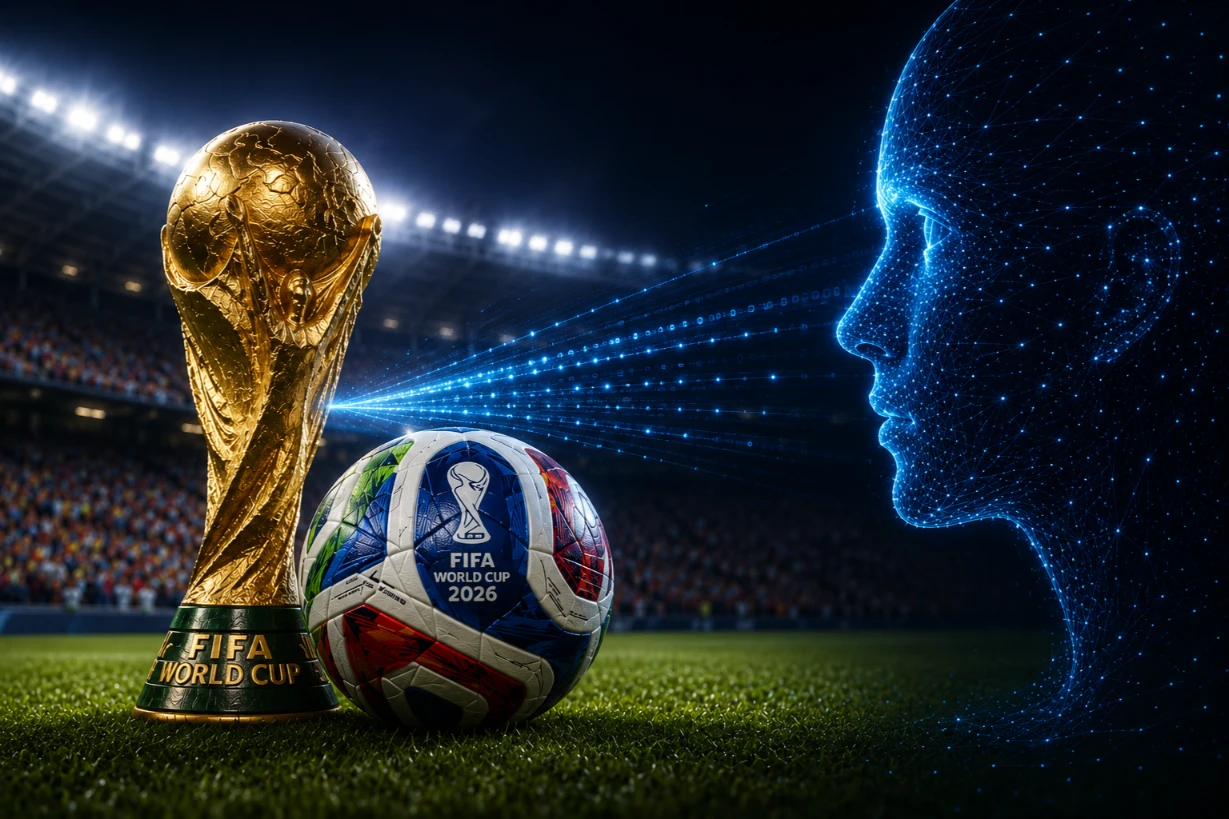
The 2026 FIFA World Cup has been rewriting the record books since it started. As the first edition to feature 48 teams, 104 matches, and 16 host cities across Canada, Mexico, and the United States, it is the largest FIFA World Cup in history.
The tournament has attracted more than 6.25 million spectators and garnered over 20 billion video views across FIFA’s digital platforms, underscoring its massive global scale.
While this is undoubtedly fascinating, we at The M Standard believe the real story lies behind the scenes.
Coordinating an event of this magnitude requires far more than organizing football matches. Every game generates vast amounts of data, with officials, broadcasters, security teams, and stadium operators having to make countless decisions in real time.
As the scale and complexity of global sporting events continue to grow, the 2026 FIFA World Cup offers a glimpse into how Artificial intelligence (AI) is driving sports’ digital transformation.
FIFA And Lenovo Partnership: 3 Key AI Innovations For The World Cup
FIFA named Lenovo its official FIFA Technology Partner for the FIFA World Cup 2026 and the FIFA Women’s World Cup 2027 back in 2024.
On January 7, 2026, the two organizations unveiled multiple AI-powered innovations.
The solutions were designed to enhance officiating technologies, strengthen match analysis and team performance, and deliver more engaging experiences for fans.
Below are three AI innovations that show why the FIFA-Lenovo partnership could be one of the tournament’s most impactful collaborations.
Football AI Pro
Football AI Pro is a generative and hybrid AI-powered knowledge assistant. It is underpinned by FIFA’s Football Language model and Lenovo’s full-stack AI capabilities.
The AI assistant analyses hundreds of millions of FIFA-owned football data points to generate insights in text, video, graphs and 3D visualisations.
Notably, Football AI Pro was made available to all 48 participating teams. This enabled the teams to access consistent, tournament-wide intelligence based on millions of data points generated throughout each match.
Key note: Advanced performance analysis has been traditionally reserved for teams with greater financial resources. By giving every team access to the same AI-powered insights, Football AI Pro represents a meaningful step toward creating a more level playing field in an increasingly data-driven sport.
AI-enabled 3D Player Avatars
FIFA and Lenovo also introduced AI‑enabled 3D avatars of every player to help in semi‑automated offside decisions and explanations.
As part of the initiative, every participating player was digitally scanned to create an accurate three-dimensional model. Although each scan took about a second, it captured precise body-part dimensions, allowing the system to track players more reliably during fast-paced or obstructed moments.
The 3D avatars have also been integrated into the host broadcast, enabling offside decisions made by the Video Assistant Referee (VAR) system to be presented in a more realistic and engaging way for both stadium spectators and viewers watching around the world.
The technology was successfully tested during the 2025 FIFA Intercontinental Cup, where players from CR Flamengo and Pyramids FC were scanned ahead of the FIFA Challenger Cup. After being trialled throughout the match, the system demonstrated that it was ready to support match officials at the 2026 FIFA World Cup.
New Iteration Of Referee View
Referee View essentially refers to a small video device securely worn on the official’s head to capture the referee’s point of view during matches. It records and transmits high-definition video and audio, which is then integrated into the live broadcast and/or used for post-match review.
For the 2026 World Cup, FIFA introduced an updated system that uses AI-powered stabilization software to smooth footage captured from the referee’s body camera.
This significantly reduces the motion blur caused by rapid movement during a match, resulting in a much clearer first-person perspective for audiences around the world.
The enhanced footage also gives fans a better understanding of the decisions referees make on the pitch, helping increase transparency and engagement throughout the tournament.
The FIFA Social Media Protection Service
As football’s global audience continues to grow, so too does the volume of online interaction surrounding the sport.
While social media has made it easier for fans to connect with players and teams, it has also increased the prevalence of online harassment.
To this end, FIFA expanded its Social Media Protection Service (SMPS) for the 2026 FIFA World Cup.
SMPS is an AI-powered system designed to protect players, coaches, referees, and match officials from online abuse across major social media platforms.
How SMPS Works
The service uses artificial intelligence to monitor millions of public posts and comments in multiple languages, identifying abusive, discriminatory, and threatening content.
Once detected, the system automatically hides offensive comments from participating individuals while reporting severe cases to the relevant social media platforms for further action.
Brief History of SMPS
Back in 2022, FIFA joined forces with FIFPRO to protect participating teams, players, officials and supporters from abuse on social media during its international tournaments.
FIFA’s participation followed an independent AI-powered study which found that more than 50% of players received discriminatory abuse during the latter stages of UEFA EURO 2020 and the 2021 Africa Cup of Nations.
The Social Media Protection Service was first introduced during the 2022 FIFA World Cup before being deployed at subsequent FIFA tournaments, including the FIFA Women’s World Cup and FIFA Club World Cup.
According to FIFA, the system has processed tens of millions of social media posts and helped reduce the visibility of abusive content directed at players and officials during the competitions.
AI In World Cup Security
With more than 7.2 million people involved in the 2026 FIFA World Cup, relying solely on human personnel for security is simply not practical.
The tournament organizers are increasingly turning to AI to help security teams monitor and control crowds, identify potential risks, and respond to incidents much faster than would otherwise be possible.
Here are some examples of how AI has strengthened security throughout the tournament.
AI-Powered Cameras & Robodogs
To anyone’s guess, the 2026 FIFA World Cup is probably one of the most surveilled sporting events in history. All the stadiums are equipped with hundreds of cameras, with many having an AI analytics layer.
Rather than simply recording footage, these intelligent cameras can flag suspicious behavior and patterns to identify potential threat actors, altercations, overcrowding, medical emergencies, and much more.
The 2026 World Cup also featured robotic dogs, including Hyundai’s Spot robot and the K9-X robot. These robots are equipped with cameras and sensors, reporting to the authorities from the crowd.
Digital Twins
Digital twins are live, virtual 3D replicas of stadiums that are continuously updated using real-time data.
By monitoring crowd density, the location of security personnel, and critical infrastructure from a single platform, authorities can identify potential problems early and intervene before they escalate.
Smart Signage
To help manage the movement of supporters around stadiums, organizers are deploying smart signage. This basically means that information on digital displays is updated according to the most current requirements.
This helps direct fans more efficiently, reduce congestion, and minimize the risk of crowd-related incidents.
AI Is Becoming Part Of The Game
The 2026 FIFA World Cup has demonstrated that artificial intelligence is no longer a futuristic concept in sports.
As tournaments continue to grow in size and complexity, we believe AI will play an even greater role in everything from officiating and performance analysis to broadcasting, fan engagement, and security.
It will not be surprising to see many of these technologies become a standard across major sporting events like the Super Bowl, Formula One, and perhaps even the Olympics.